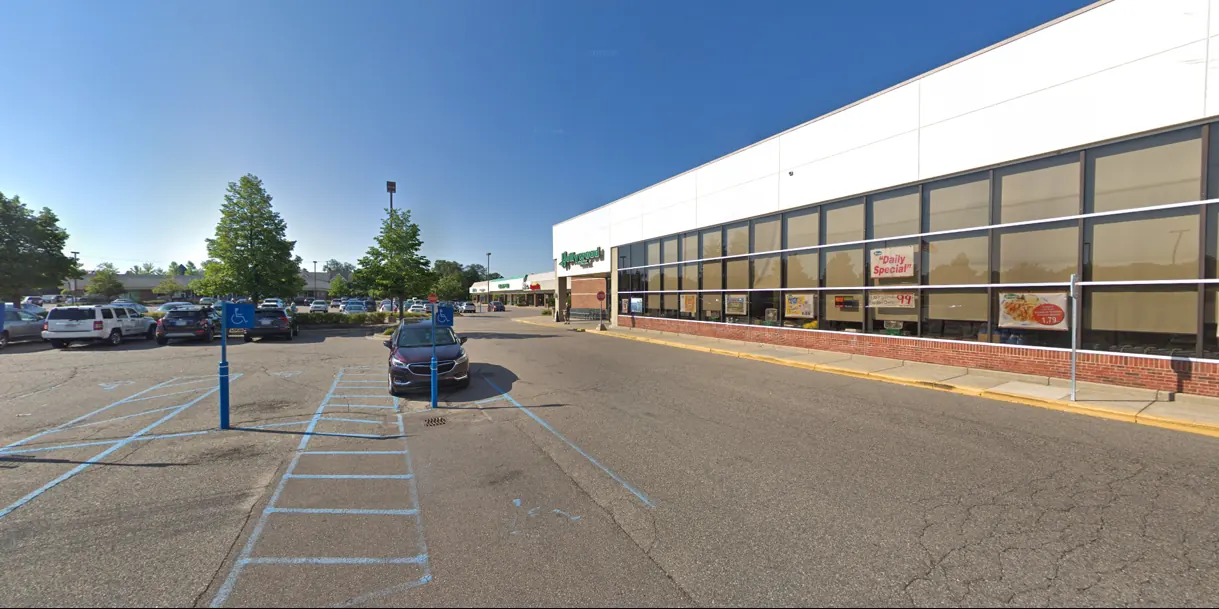
Eastpointe's retail corridors are concentrated along Gratiot Avenue and Nine Mile Road, both long-established commercial spines serving a dense, older residential base in eastern Macomb County near the Detroit border. Building stock along these corridors generally dates from the mid-20th century onward, with a mix of freestanding retail buildings, small strip centers, and older auto-oriented commercial buildings reflecting the corridor's decades-long build-out. Gratiot Avenue's platting here follows the deep, pylon-sign-oriented lot pattern typical of a mid-century state trunkline retail corridor — narrow-frontage parcels running back several hundred feet from the road, with the original freestanding pylon sign, rather than the building itself, doing most of the work of capturing highway-speed traffic. That lot geometry, combined with generous curb cuts from an era before access-management standards tightened, is a defining physical characteristic buyers should factor into redevelopment or outparcel planning.
Because much of the retail stock is older, building condition varies significantly from property to property, and deferred maintenance is a more common underwriting consideration here than in newer suburban retail corridors. Most of the strip center bays along Gratiot run small — commonly 1,000 to 2,000 square feet — sized for independent service tenants like nail salons, phone-repair shops, check-cashing operations, and small restaurants rather than the larger-format tenants seen on corridors further out in Macomb County. Buyers should conduct direct property condition assessments rather than relying on corridor-wide assumptions about building quality.
Eastpointe's position directly against the 8 Mile Road/Detroit border creates a distinct edge-condition dynamic for the city's southern commercial parcels, where trade-area demographics, perceived security, and property values can shift meaningfully within a few blocks. Buyers evaluating parcels near that edge should treat it as its own micro-submarket rather than assuming it behaves like Gratiot Avenue further north toward Nine Mile Road.
Zoning along Gratiot Avenue and Nine Mile Road is predominantly commercial, supporting a broad range of retail, service, and restaurant uses consistent with the corridors' historic auto-oriented commercial character. Confirm current zoning classification and any recent overlay or corridor improvement initiatives with the city before underwriting redevelopment.
The tenant base along these corridors skews toward value-oriented and independent retailers, service businesses, and quick-service or fast-casual restaurants serving the surrounding residential population, with less national big-box presence than in corridors like Novi's Grand River Avenue. This tenant profile reflects the corridor's role as a neighborhood-serving retail spine rather than a regional retail destination. Restaurant tenants in these small-bay spaces frequently operate without full hood-and-exhaust kitchen buildouts, and any conversion from a retail or service use to a food-service use should be underwritten with an honest assessment of what grease venting and utility capacity the existing bay can support without a costly mechanical retrofit.
A buyer evaluating Eastpointe retail should assess building condition directly given the age of much of the stock, confirm current tenant lease terms and any deferred capital obligations, and evaluate traffic counts along Gratiot Avenue versus the more residential-serving Nine Mile Road frontage. Redevelopment potential on larger parcels should be weighed against current zoning and any city corridor revitalization plans.
Basis: Building specifications, ranges and submarket detail on this page reflect C3's transaction experience in this submarket, not a published dataset.