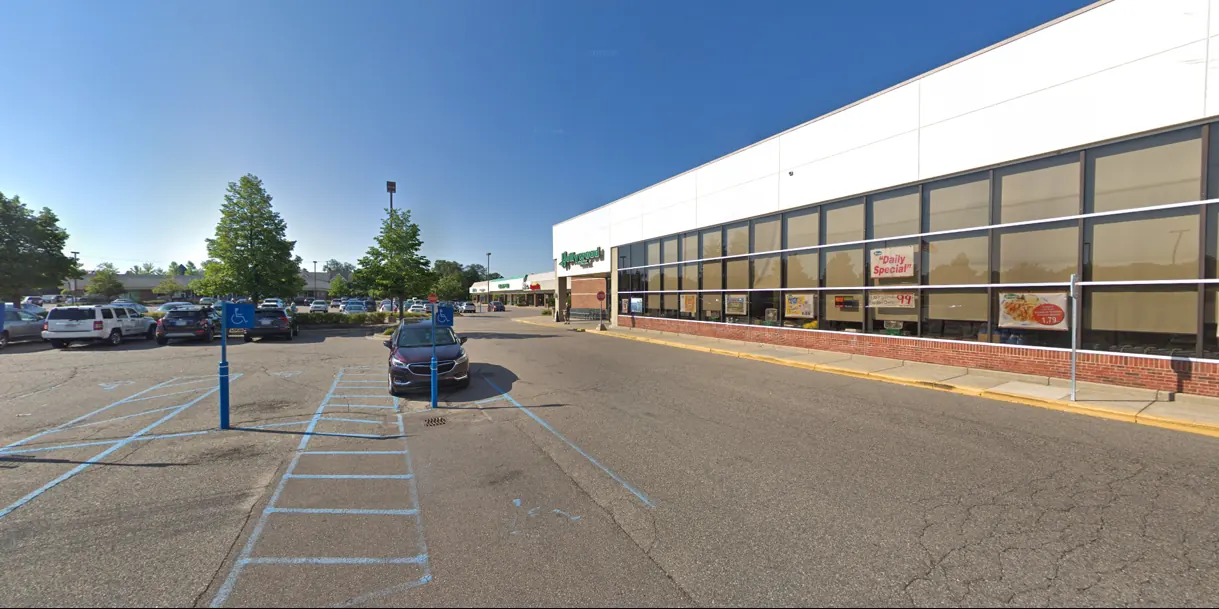
Roseville's retail market is built around Gratiot Avenue, one of Macomb County's oldest and busiest commercial corridors, along with the surrounding area historically influenced by the former Eastland Center regional mall site. Decades of retail development along Gratiot have produced a mix of large-format retail buildings, older strip centers, and freestanding pad sites, with vintage and condition varying widely depending on when each parcel was last redeveloped. As in Eastpointe further south along the same trunkline, Roseville's Gratiot frontage follows a deep-lot, pylon-sign-oriented platting pattern from the corridor's mid-century build-out, with many parcels running several hundred feet back from the road behind a single large freestanding sign — a physical layout that continues to shape how outparcels and pad sites are carved out of larger holdings today.
Because Gratiot Avenue has been a commercial corridor since the mid-20th century, building stock ranges from well-maintained, recently renovated retail buildings to older strip centers showing significant deferred maintenance. Much of the strip center product carries small-bay tenancy in the 1,000 to 2,500-square-foot range, built for independent service and retail operators rather than larger-format national tenants, alongside a handful of bigger-box buildings dating to the corridor's mid-century department-store and discount-retail era. Buyers should conduct direct property condition assessments and not assume uniform quality along the corridor given this wide range of vintage and reinvestment history.
Zoning along Gratiot Avenue and the surrounding commercial areas is predominantly commercial, supporting retail, restaurant, and service uses, with some parcels near the former Eastland Center site subject to more specific redevelopment planning given the mall's closure and the site's subsequent repositioning. Confirm current zoning and any area-specific redevelopment plans directly with the city before underwriting a project tied to that immediate area.
The tenant base includes national retailers, regional chains, and independent retail and service businesses serving Roseville's dense residential population, with Gratiot Avenue's traffic counts historically supporting a broad range of tenant types from quick-service restaurants to larger-format retail. This traffic-driven demand differentiates Gratiot from Roseville's smaller side-street commercial areas. Restaurant tenants leasing into the corridor's older small-bay stock should confirm existing grease-trap and hood-venting infrastructure directly, since many of these bays were not originally built for full commercial kitchen use and a build-out from a prior retail or service tenancy can carry meaningful mechanical retrofit cost.
A buyer evaluating Roseville retail should assess building condition and vintage directly, confirm current zoning status particularly for parcels near the former Eastland Center site, and evaluate Gratiot Avenue traffic counts and curb-cut access as the primary drivers of tenant demand. Redevelopment opportunities on larger or underutilized parcels should be weighed against the corridor's ongoing repositioning trends.
Basis: Building specifications, ranges and submarket detail on this page reflect C3's transaction experience in this submarket, not a published dataset.